
Surprising Judo principles
For a powerfully harmonious life

I love coming across words or phrases from other cultures that offer something my own language doesn’t quite hold. It feels like discovering a small key that unlocks a door in the mind. Suddenly, something you sensed but couldn’t articulate now has shape.
I love Japanese culture. This is no secret; I mention it every five minutes. And if no one is around, I marvel at it quietly to myself.
Anyone who has ever visited Japan will have noticed what a kind, obliging and hospitable culture it is. There’s a quiet attentiveness to others that runs through daily life — not showy, not performative, just woven into the fabric of how people move through the world together.
This week I discovered a book by the founder of Judo, Jigoro Kano (1860–1938), called Mind Over Muscle. I read all 168 pages online on my phone in one sitting.
Judo’s moral code is known as “the way of gentleness.” And Kano built the philosophy of Judo — and life — around two key principles: Seiryoku Zenyo and Jita Kyoei.
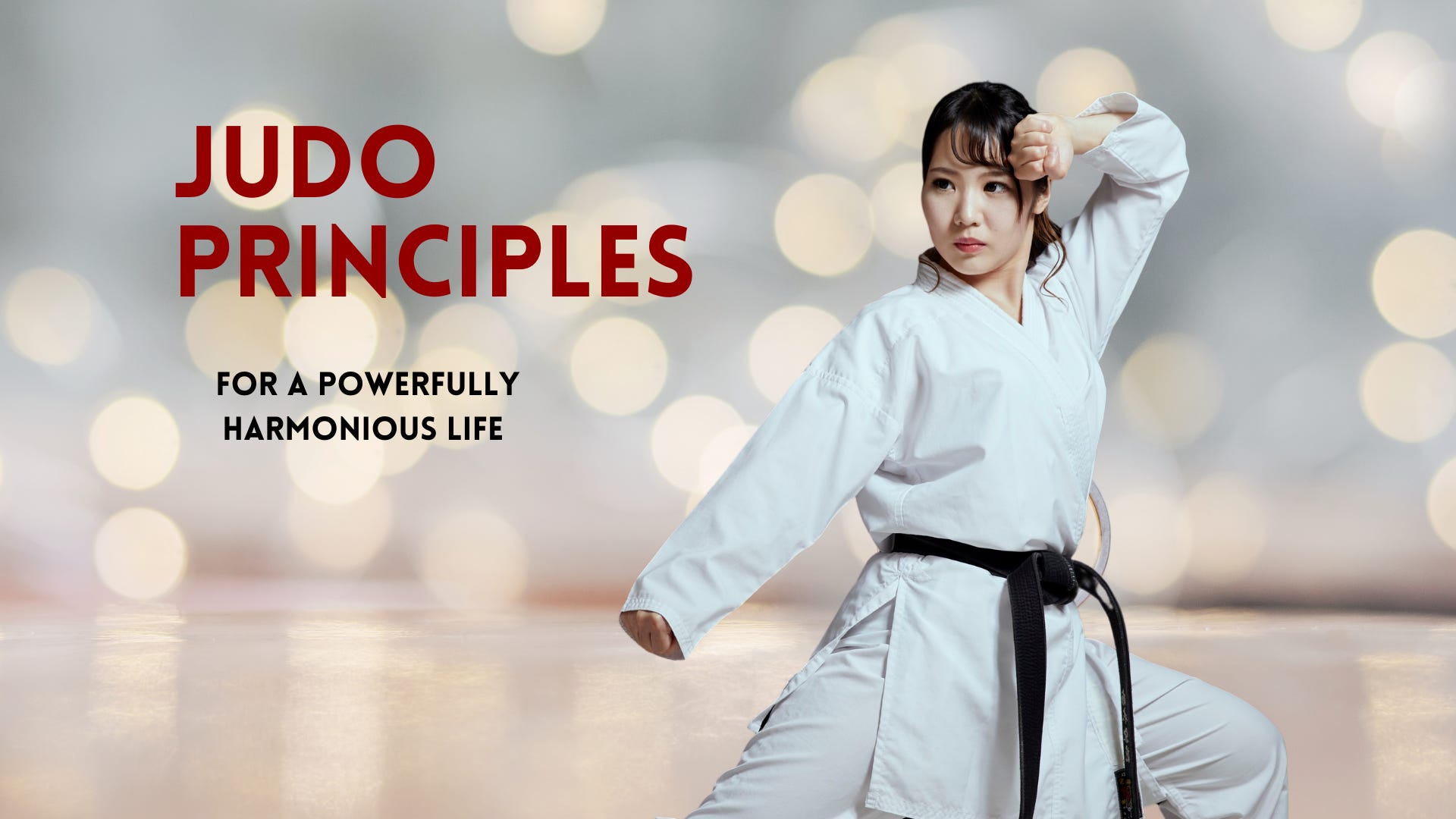
Seiryoku Zenyo translates roughly as maximum efficiency. It means using your energy wisely — not wasting effort, not forcing what does not need forcing, and learning to move with life rather than against it. The principle asks us to refine our actions so that our effort is thoughtful, skilful, and purposeful.
I hadn’t come across this phrase before, but as I read about it, I realised it’s actually a wonderful way to structure one’s activities in life. Instead of scattering our energy across endless distractions, we focus it where it can do the most good.
But the second principle, Jita Kyoei, immediately felt like home.
Jita Kyoei means mutual benefit or mutual flourishing. It holds the idea that our actions should not only serve ourselves but contribute to the wellbeing of others. And when this happens — when individuals act with the whole in mind — everyone thrives.
The moment I read it, I thought: This is what I’ve been trying to say for years.
The ethos of the Shared Light Collective has always been based on the belief that each of us carries gifts — skills, insights, experiences — that can contribute to the wellbeing of others. I often talk about people bringing their “light” into a shared space where it can benefit the whole. But until now, I didn’t have a concise phrase for it.
I simply ramble enthusiastically about people coming together for the common good of all life.
But Jita Kyoei gives that intuitive feeling about how we best could live, a structure.
Seiryoku Zenyo and Jita Kyoei work together beautifully. We develop our personal abilities with care and discipline, but those abilities are not meant to remain locked inside the individual. They ripple outward. Our growth becomes of benefit to others.
It’s a way of living where personal development and collective wellbeing are not competing forces — they are entwined.
This aligns perfectly with the path I’ve been exploring lately around widening our circles of care. Yes, of course we grow and evolve for ourselves, but it doesn’t need to stop there, otherwise it can stagnate. Instead of stagnation, our growth and evolution can inform, heal, support and evolve others, if we allow it to flow from us.
And yet, this way of thinking runs directly against the cultural current many of us have been swimming in for decades.
Modern neoliberal culture has spent a long time convincing us that we are primarily individuals — separate islands competing for resources and recognition. Success becomes something we achieve alone. Worth becomes something we prove by outperforming others in different metrics.
The message has been relentless: look after yourself and your own first and only.
Build your brand. Build your walls. Protect your interests. Secure your advantage.
But if we step back for a moment, we can see that logic leads to despair, distrust and destruction.
Self-service, when elevated to the highest virtue, quietly erodes the very systems that sustain us.
The truth is far simpler, and far older.
We thrive together.
Human beings have always depended on cooperation, reciprocity and shared responsibility. For most of our history, survival itself required a strong sense of we. The idea that we are entirely self-made individuals is a relatively recent — and rather fragile — story.
Jita Kyoei gently reminds us of something we already know deep down: that our wellbeing is tied to the wellbeing of others.
Not just other humans, but the wider living world that sustains us.
When we act with this awareness, something changes. Our choices become less about extracting value and more about adding value to the whole. Our skills become contributions rather than possessions.
Contribution begins to feel like a natural expression of belonging.
This is the spirit I hope the Shared Light Collective can nurture — a place where people are encouraged to develop their gifts not only for personal fulfilment but for the benefit of the wider community of life.
It’s not about self-sacrifice, martyrdom or being performative.
Just the quiet recognition that when our actions contribute to the flourishing of others, something in us flourishes too, there’s a natural reciprocity to life.
Do you want a future shaped by a few egoic individuals with selfish agendas? Or can you imagine a future shaped by people who act for the goodness of the whole, so all of life has a chance to live it’s potential?
The future is Shared. It’s a Collective. It’s made of Light. Come Join us!
Just last be night I dreamt of myself holding hands with a lot of other people and floating around the sun! I knew immediately that all the other people for how different they may look that they were me! We are one. Aren’t we?